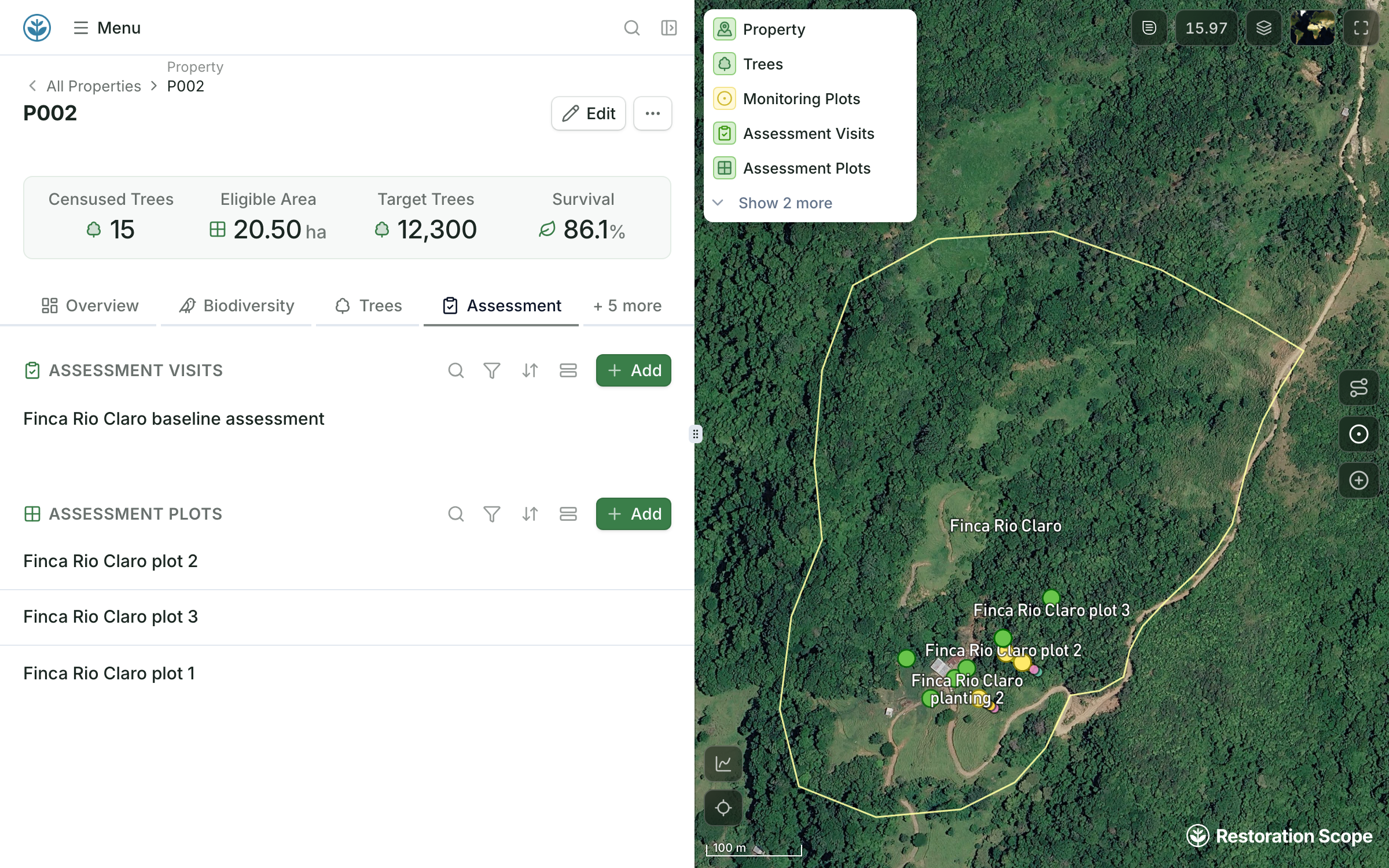
Each visit is filled inside its site
A farm keeps its boundary, plots and visits together. A visit added here is linked to the farm and counts in its totals once it syncs.
KoboToolbox is a proven tool for collecting survey forms, free for nonprofits. Restoration Scope is the system that runs a nature project: its sites, field work, surveys, maps, results and funder reporting. It builds its own surveys, and they are filled inside the project, so a visit lands on the site or plot it is about. Kobo forms can still feed it, but for operations its own surveys work better: each starts tied to its site, with choices from the records the project already keeps.
 Restoration Scope
It depends on the job, and for most projects that is operations. Where every visit must stay tied to the right site and plot season after season, fill the survey in Restoration Scope: it is linked to its site as it is filled, picks from the records the project keeps, and counts in the project totals once the phone syncs. For a standalone questionnaire, such as a household survey, with someone to own the form, KoboToolbox is proven and free for nonprofits. Kobo forms that already work can keep feeding the same record.
Restoration Scope publishes this comparison and is one of the options. We list it first because we think it's the best fit for most projects: it adapts to each project and grows with it, and covers operations and costs as well as fundraising and reporting. No vendor paid to be included. Something out of date? Write to info@restorationscope.com.
| Restoration Scope |  KoboToolbox | |
|---|---|---|
| What it is | The system that runs a nature project: sites, field work, surveys, maps, results and funder reporting. The field app and its surveys are part of it. | A general data-collection platform from a nonprofit, used in humanitarian, development and environmental work. |
| Cost | A free pilot on a sample of your data, then a platform license plus implementation, quoted after a scoping call. | As of October 2026: the Community plan is free for nonprofits, including government, UN and education, with 5,000 submissions a month and 1 GB of files. Paid nonprofit plans are $159–289 a month ($129–249 billed yearly); other organizations pay $25–359 a month. |
| Setup | Configured with our team around your project, surveys included; Kobo forms you already use are rebuilt during setup. Someone on your side owns the workflow. | Self-serve form builder or XLSForm, with 25 question types, skip logic and multilingual forms. |
| Offline capture | Restoration Scope Field works offline: points, lines, polygons and photos. | KoboCollect on Android and web forms both work offline. |
| Where a survey is filled | Inside the record it is about: open a site or plot, add the visit, and it is linked to it. Questions show only when they apply, and later steps open on the same record, such as consent, then onboarding, then the tree count. Pick lists come from the project, such as its sites and species. | In a form of its own. Forms can pull lists such as sites from another project, but you design and maintain those links yourself. Without them, the same site can be entered twice. |
| Catching errors | Required questions, number limits, project pick lists and a weak-GPS warning as it is filled. We also set up GPS checks, such as a tree outside its farm or a point inside another site, and checks that flag problem records, such as a boundary that crosses itself or overlaps another. | Constraints check each answer as it is entered. Reviewers mark submissions approved, not approved or on hold in the data table. |
| Maps | Sites and records on one project map, with geospatial data layers. | Point, line and area questions, a map of submissions, and GeoJSON export for GIS. |
| Results and reporting | A synced record counts in the project totals, with no export or import step. Donor portals are built from the same records. | Custom reports with charts and tables, plus exports and live data links that feed Excel, Power BI or Google Sheets dashboards. |
KoboToolboxTeams fill in Kobo forms in the field.Restoration ScopeSubmissions join the sites and records they belong to.Restoration ScopeProject pages and donor portals count them.Kobo forms that already work can stay in the field. Restoration Scope brings their submissions in on a schedule, set up for each client, and links them to the sites they belong to.
Checked against KoboToolbox's own pages on October 28, 2026: Features, Pricing, About Kobo, Data collection tools, Validation criteria, Validating data, Exports, Synchronous exports, Maps, Custom reports, Linking forms, Trillion Trees template forms.
These are Restoration Scope screens from our demo project and a public donor portal. To see KoboToolbox, visit its own site.
A farm keeps its boundary, plots and visits together. A visit added here is linked to the farm and counts in its totals once it syncs.
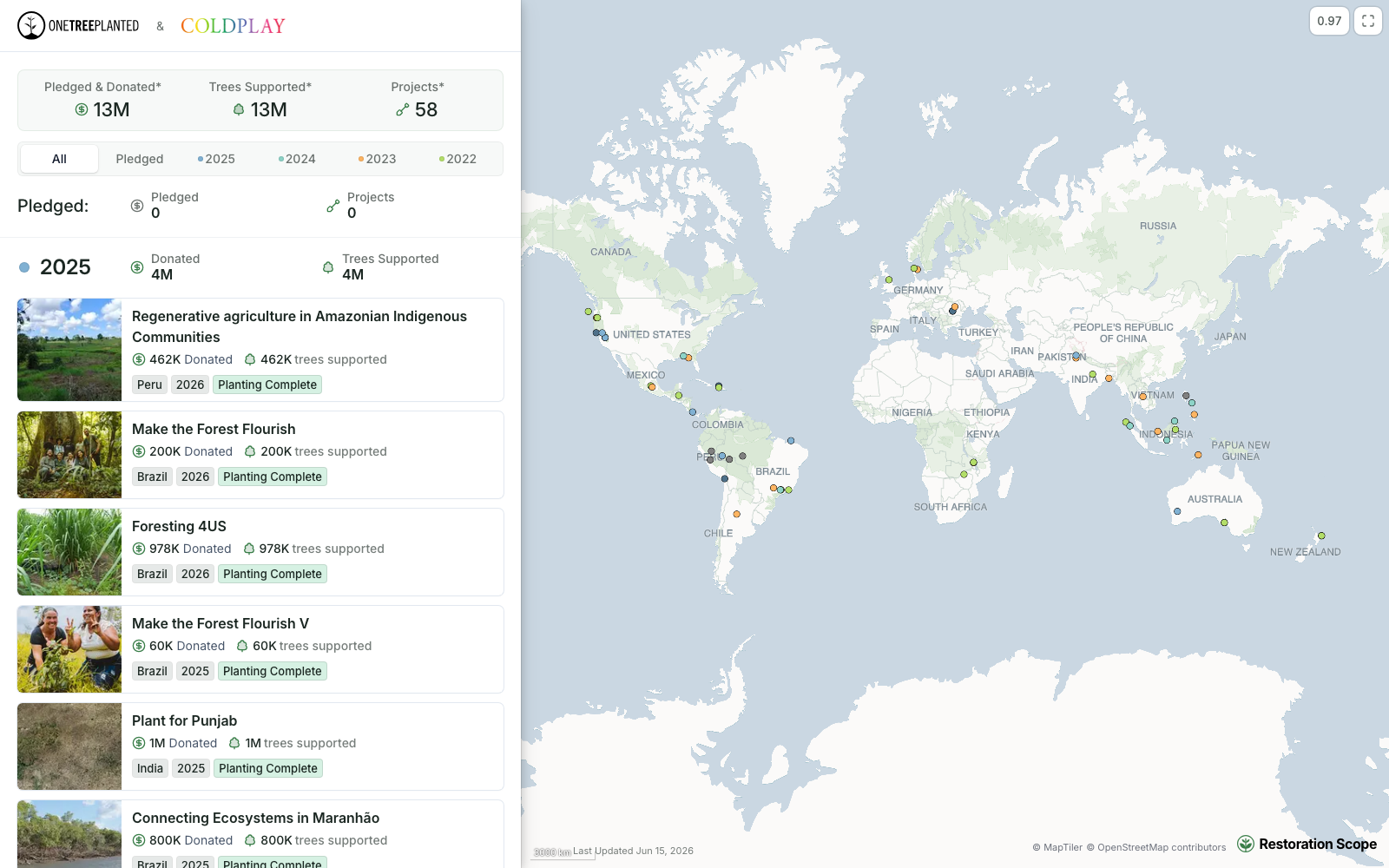
Each funder gets their own portal: their totals, then every project they support, built from the records the team keeps.
KoboToolbox is a survey app that works as one part of a network of tools, beside a spreadsheet and a GIS. Restoration Scope is an adaptable platform: it runs its own surveys inside the project, takes in Kobo submissions, and keeps both in one record with land, sites and maps.
Where restoration records live, from word of mouth to custom softwareYes, for surveys that are part of running a project. Restoration Scope builds its own surveys, with questions that show only when they apply, filled in its field app inside the site or plot they are about. It also replaces the spreadsheets, scripts and reports teams build around Kobo. For a standalone questionnaire, Kobo is proven and free for nonprofits.
Yes, within limits. As of October 2026, its Community plan is free for nonprofits, including government, UN and education organizations, up to 5,000 submissions a month. Companies, such as for-profit carbon project developers, pay from $25 a month.
Yes, in two ways. Kobo can stay in the field: we map your form fields to project fields and bring submissions in. Or we rebuild your Kobo forms in Restoration Scope during setup, so they are filled inside the project, where linked visits and checks matter most.
KoboCollect is built from ODK Collect and both read XLSForm, so collection works much the same. Hosting, pricing and how records link across forms differ: ODK can be self-hosted or rented as ODK Cloud.
Another question? Email us or book a call.
Bring in the spreadsheets, field forms and maps you already use, and see every site in one place.