
Each visit lands on its site
A site keeps its boundary, monitoring plots and visits together, so a record attaches to the site it belongs to.
Restoration Scope is the system that runs a nature project: field teams record visits and surveys offline in its field app, and every record stays tied to the site, planting and season it belongs to, through to funders. CyberTracker is field data collection software from a South African nonprofit, built with expert trackers and known for an icon interface that people who do not read can use.
 Restoration Scope
For most restoration and carbon projects, Restoration Scope: field teams record offline in its field app, every record stays tied to its site, planting and season, and the same records run the work and reach funders. CyberTracker is the better pick for observations such as wildlife sightings, tracks or transects recorded by people who may not read, with low yearly fees and free access for eligible projects. The two can work together: CyberTracker can submit to KoboToolbox, and Restoration Scope takes in Kobo submissions.
Restoration Scope publishes this comparison and is one of the options. We list it first because we think it's the best fit for most projects: it adapts to each project and grows with it, and covers operations and costs as well as fundraising and reporting. No vendor paid to be included. Something out of date? Write to info@restorationscope.com.
| Restoration Scope | ||
|---|---|---|
| What it is | The system that runs a nature project: sites, field work, surveys, maps, results and funder reporting. The field app and its surveys are part of it. | Field data collection software from CyberTracker Conservation, a nonprofit in Cape Town: CyberTracker Online for design and reports in the browser, a phone app, and the older Windows-based Classic. |
| Cost | A free pilot on a sample of your data, then a platform license plus implementation, quoted after a scoping call. | As of October 2026: Online is free for Indigenous communities, community science, humanitarian projects and students who apply. Others pay ZAR350–3,400 a year (about US$20–200), by observations stored. Classic is freeware. |
| Setup | Configured with our team around your project. Someone on your side owns the workflow. | Self-serve: build screens from templates in the browser, publish, and phones install the app from a QR code. The app can also run XLSForms from ODK Central, KoboToolbox or Survey123. |
| Field capture | Restoration Scope Field works offline: points, lines, polygons and photos. | Works offline, with GPS on every save, timed track logs and offline maps. An icon-only interface lets non-literate experts record complex observations. |
| Knows your project | The app carries your sites, species and plots, so a visit attaches to the site it belongs to. | Each observation saves its place, time and the answers on screens you design. Its pages do not describe linking an observation to a site or earlier visits. |
| Maps and data | Sites and records on one project map, with geospatial data layers. | Map and table views with saved filters, plus photo and audio tables. Exports to CSV, GeoJSON, KML and KMZ. |
| Donor reporting | Donor portals built from the same records the team keeps. | Exports, or data sent by webhook to a reporting server you run. |
 KoboToolboxSubmissions land in the Kobo project.Restoration ScopeThey join the sites and records they belong to, on the project map and in donor portals.
CyberTracker can collect with an XLSForm and submit to KoboToolbox, and Restoration Scope takes in Kobo submissions, so field teams can keep the CyberTracker app and add the system around it.
Checked against CyberTracker's own pages on October 19, 2026: CyberTracker, CyberTracker Online, Pricing, New features, Build a simple app, XLSForm support, KoboToolbox connector, CyberTracker Classic FAQ, Offline maps, Contact.
These are Restoration Scope screens from our demo project and a public donor portal. To see CyberTracker, visit its own site.
A site keeps its boundary, monitoring plots and visits together, so a record attaches to the site it belongs to.
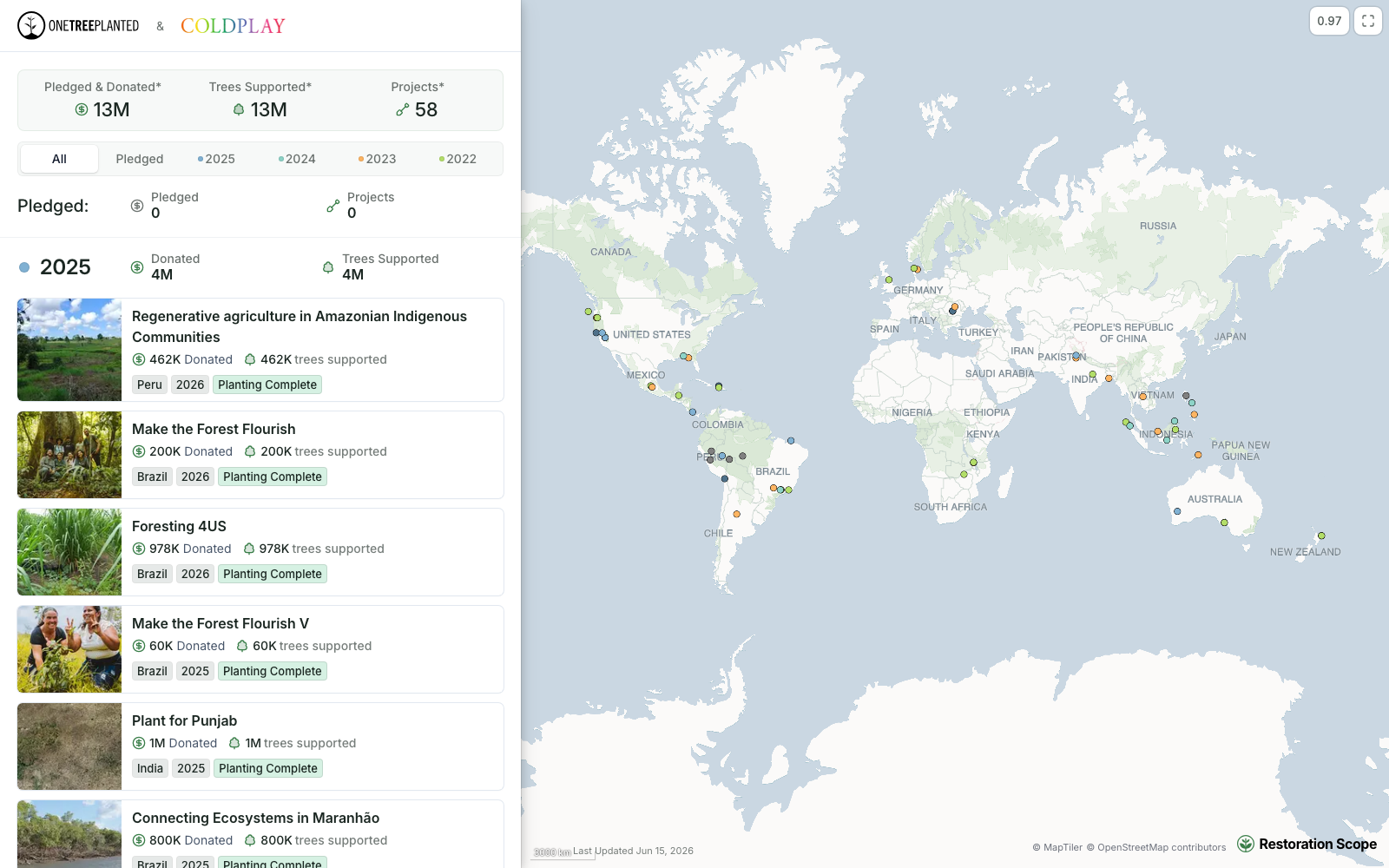
Each funder gets their own portal: their totals, then every project they support, kept current by the records the team keeps.
CyberTracker collects observations and keeps them in CyberTracker Online or a server such as KoboToolbox, one part of a network of tools. Restoration Scope is an adaptable platform that keeps field records in one system with sites, plantings and maps.
Where restoration records live, from word of mouth to custom softwareFor most projects, yes: Restoration Scope runs field capture, sites, seasons and funder reporting in one system, and replaces the spreadsheets and reports teams build around field records. For observations recorded by non-literate experts with an icon interface, CyberTracker was built for that and stays the better pick.
Often. As of October 2026, CyberTracker Online is free for Indigenous communities, community science, humanitarian projects and students who apply with a project description and photos, which CyberTracker may publish. Others pay about US$20–200 a year, by the number of observations stored. CyberTracker Classic is freeware.
Yes. The CyberTracker app collects XLSForms from ODK Central, KoboToolbox and Survey123 and submits to them, adding options of its own such as icon screens and track logs. Those options live in the XLSForm, so it is kept outside Kobo’s form editor and redeployed after each change.
Yes. Submissions sent to KoboToolbox come in through our Kobo connection, and GeoJSON, KML and KMZ exports come in as map layers tied to your sites.
Another question? Email us or book a call.
Bring in the spreadsheets, field forms and maps you already use, and see every site in one place.