Plan Vivo vs Gold Standard vs Verra for Smallholder Agroforestry
Compare Plan Vivo, Gold Standard and Verra for smallholder agroforestry carbon projects by methodology, audits, forward credits, farmer share and fees.

Plan Vivo or Verra? Plan Vivo was built for smallholders: at least 60% of credit-sale income must benefit participants and local stakeholders, PM001 allows forward credits, and small projects can use independent experts instead of a VVB. Verra brings the largest market, an ICVCM-labelled methodology for trees on farms and credits that can qualify for CORSIA, but issues credits only after verification. Verra or Gold Standard? Gold Standard adds forward credits for up to five years and certified SDG impacts, but its reforestation methodology is being replaced and ICAO excludes its land use and forestry credits from CORSIA for 2027–2029.
Smallholder projects face the same problem under all three: thousands of small plots, trees planted among crops, and farmers who need income years before the trees have grown. This guide compares the three by the questions that decide the choice; for the two-registry comparison in depth, see Verra vs Gold Standard.
It compares published rules, not outcomes, and is not legal or investment advice. First-party documents checked October 17, 2026; Gold Standard's methodology transition and CORSIA status checked November 2, 2026. For the wider field, including ACR, the Climate Action Reserve and Isometric, see carbon standards for nature projects compared.
Compare the three standards
| Question | Plan Vivo | Gold Standard | Verra VCS |
|---|---|---|---|
| Methodology for trees on farms | PM001 (smallholder and community land use), PM002 (small-scale agroforestry) | A/R methodology, which covers agroforestry and silvopasture | VM0047 census-based, for up to 50 planting units, such as trees or shrubs, per hectare |
| Who audits | A VVB, or independent experts for projects issuing 10,000 credits a year or fewer | A VVB; approved individual auditors for some later smallholder certifications | A VVB |
| Credits before trees grow | Partly: forward credits under PM001, capped at 90% of the expected benefit; none under PM002 | Yes, forward credits (PERs) for up to five years, except for smallholder projects using default values | No; credits are issued after verification |
| Share for farmers | At least 60% of credit-sale income, after host-country charges, must benefit participants and local stakeholders over the crediting period | No fixed share in the rules we checked | Benefit-sharing rules strengthen under VCS version 5 |
| Verification at least | Every 5 years | Every 5 years, with a VVB site visit at least every 3 years | Every 5 years for most monitored values |
| Crediting period | 10–50 years | 30–50 years for A/R | Set by the VCS rules for ARR |
| ICVCM label for the methodology | Program CCP-eligible; PM001 and PM002 not listed as approved | Program CCP-eligible; A/R methodology under assessment | Program CCP-eligible; VM0047 approved |
| Issuance fee | $0.40 per credit up to 50,000 a year | $0.25 per credit | $0.23 per tonne claimed at verification, net of buffer credits |
Where each fits
 Plan Vivo
Good fit: Projects designed with and for the farmers. Plan Vivo was built for smallholders and communities, and its rules put the participants' share in writing. The microscale route, with independent experts instead of a VVB, keeps audit costs proportionate for small projects. Acorn's smallholder agroforestry program certifies under Plan Vivo's PM002 methodology, which measures removals with remote sensing.
Think twice if: Your buyers ask specifically for ICVCM-labelled credits. Check the assessment status for the methodology you would use.
Sources: 
methodologies, fees.
 Gold Standard
Good fit: Projects that need early income and want to report sustainable-development outcomes. Forward credits for up to five years of expected removals can fund planting and early maintenance; 20% of them go to Gold Standard's buffer, which the STARR draft would set at 10% to 20%. Annex B of the land-use requirements simplifies the rules for smallholder projects, with no size cap.
Think twice if: You need forest inventory precision on scattered trees. Under methodology 2.1, plots must reach ±20% precision at 90% confidence, or the excess error is deducted; the STARR draft tightens this to ±10%. That is harder to meet when trees are spread thinly across many farms. A new project also builds on STARR, the draft replacing the A/R methodology, and applies the final version before validation; see Verra vs Gold Standard.
Sources: land-use requirements, A/R methodology v2.1, fees.
 Verra VCS
Good fit: Projects that need the largest buyer market and the ICVCM label today. VM0047's census-based approach was written for trees on farms: count every planted tree, keep each one findable with a GPS point or a marked tag, and measure a sample. The land stays in farming, so there is no leakage deduction.
Think twice if: You need income before the first verification, or your farms plant more than 50 trees per hectare, which moves them to the area-based approach. The census also means every tree needs an ID that survives years of fieldwork. See what VM0047 asks you to record.
Sources: VM0047, VCS version 5, fees, fee FAQ.
What all three need from the field
Whichever standard you choose, a smallholder project lives or dies on its farm and tree records:
- Farmer and farm. Who the participant is, their agreement, and the farm boundary.
- Planting. What was planted, where and when, by cohort.
- Trees or plots. A stable ID for every tree or sample plot, with location and photos.
- Monitoring visits. Survival, measurements and who recorded them, visit after visit. See how to track tree planting survival.
- Payments. What each participant received, for standards that check benefit sharing.
Collecting these on paper or in separate spreadsheets per field officer works for a pilot. At thousands of farms, IDs drift, photos lose their tree, and verification becomes a reconstruction. Restoration Scope keeps farmer, farm and tree records connected on one map, with offline capture for field teams. See Restoration Scope for carbon projects.
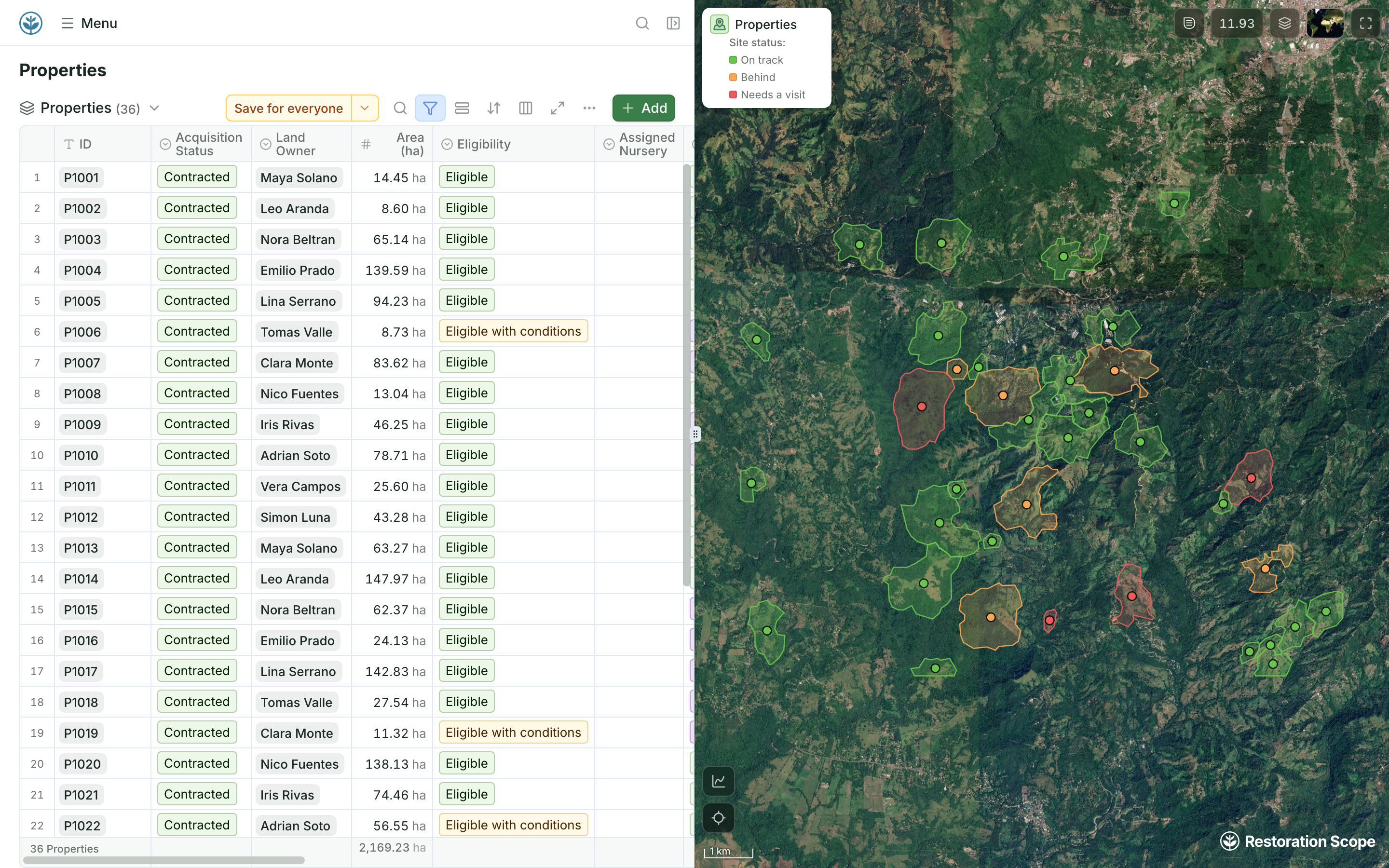
Properties and landowners on one map.
Properties and their landowners in a table, beside their boundaries, coloured by whether each site is on track, behind or needs a visit. Demo project: names and numbers are made up.
More guides: carbon standards for nature projects compared and VM0047 field data for ARR projects.
Disclosure: Restoration Scope makes field and monitoring software for carbon projects. We are not a standard, a registry or a verifier, and we don't issue credits.
Questions smallholder project developers ask
Which carbon standard is best for smallholder agroforestry?
Plan Vivo is designed for smallholders and requires at least 60% of credit-sale income to benefit participants and local stakeholders; Verra offers the largest market and an ICVCM-labelled methodology; Gold Standard offers forward credits and co-benefit reporting. The right choice depends on your buyers and how you fund the early years.
Can smallholder projects get carbon finance before trees grow?
Sometimes. Gold Standard issues forward credits, though not to smallholder projects that use default values, and Plan Vivo issues them under PM001 but not PM002. Verra issues credits only after verification.
Is Plan Vivo cheaper than Verra?
Plan Vivo's issuance fee is higher per credit, but projects issuing 10,000 credits a year or fewer can use independent experts instead of a VVB, which can cost less. Compare the full cost, including validation, verification and project design.
Does VM0047 work for trees on farms?
Yes. Its census-based approach is for planting that doesn't change land use, at up to 50 planting units, such as trees or shrubs, per hectare, with every tree identified by GPS or a physical marker.
How often are smallholder carbon projects verified?
At least every five years under all three standards. Gold Standard also requires a VVB site visit at least every three years.
Another question? Email us or book a call.